


You’re staring down foundation trouble on your slab home, and you’re not sold on fixing it. Maybe you’re weighing different methods, or wondering whether to repair at all. Foundation repair is a big expense. Understandably, no one wants to hand over that kind of money only to end up worse off or feel like you got burned.
You’re the kind of person that wants to know the *what could go wrongs* because it helps you decide what’s right for you. We got you.

At Anchor Foundation Repair, we’ve spent 40+ years keeping worst-case scenarios off our job sites. We won’t pretend we’re perfect. Every so often we learn a hard lesson, fix our process, and take steps to make sure it never happens again. We’ve also heard plenty from homeowners about repairs (not ours) that went wrong, so we know these situations are out there.
In this article, we’ll walk through what can actually go wrong during a slab foundation repair and how likely each problem is. Then, we’ll discuss what you can do up front to keep any of it from happening at your home. This is not to freak you out, but it’s an honest look at the realistic risks so you can make a confident call.
1. Misdiagnosis of the Real Problem

The first risk is a wrong diagnosis, and it’s the sneaky root of several others here. If the inspector/estimator misreads what’s happening with your home and builds a bad or inaccurate repair plan for your home, you can spend good money solving a problem that wasn’t there, or was too small to matter.
Worse, chasing the wrong fix can create a brand-new problem that then needs its own repair . . . and sometimes that one can’t be undone.
A common version of this scenario: the real issue is drainage or a plumbing leak, but the home gets piered anyway. The supports go in, the check clears, and the actual cause keeps right on doing damage.
A good assessment reads the problem signs correctly instead of reacting to the first symptom it sees.
Of everything on this list, a bad diagnosis is the one to guard against most closely. It can set you up for other issues besides wasted money, like over-raising, or repairs that don’t solve your issue. Getting a second opinion on what’s going on at your home and how to repair it is always a good idea for due diligence.
How Likely Is a Misdiagnosis?

A foundation issue misdiagnosis is unfortunately common, and almost always tied to who you hire and the knowledge behind the initial foundation inspection. It happens routinely with inexperienced companies, contractors more interested in making a sale than really solving your issue, crews that don’t account for a recent remodel, or anyone who doesn’t stop to listen to what you’re actually experiencing.
It’s also one of the most avoidable problems on this list. We’ll offer tips below to help you select a reputable contractor.
2. Drain Lines Left Leaking Under Your Home After Raising
When a slab gets raised, the plumbing buried under it moves along with the raised slab. Compromised drain lines, and aging cast iron lines, can crack or pull apart during the lift or may have been damaged as the home settled.
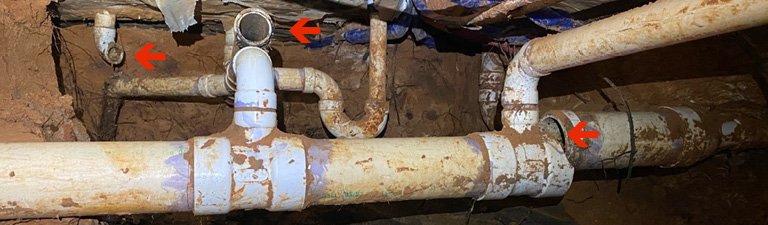
If nobody tests your under-slab drain lines afterward, a fresh leak (or one that has been there all along) can go unnoticed and keep feeding water into the soil under your slab.
That water softens the ground and expands the soil, and a home on wet clay can keep moving. A missed leak can also void your warranty later, since a company can point to it as the cause of new movement.
Many other companies do not check for this issue or leave it to your discretion in the fine print of your contract. A post-raise plumbing test is cheap insurance against a slow, hidden problem. We include a hydrostatic pressure test as part of our repairs.
Drain lines will need to be repaired if leaks are found (at homeowner’s expense). Yes, that does cost more money for you, but do you really want to leave leaks under your home that can undo the foundation work you just had done?
How Likely Are Leaking Drain Lines?

We encounter leaking drain lines under about 30% of the homes we repair, so it’s a fairly common occurrence. For other companies, it’s hard for us to put a number on. Most contractors offer a plumbing test but leave the call to the homeowner, and we usually only hear about it when a skipped test turns into a still-moving home.
Our view is biased toward the jobs that went wrong, so take this as a caution, not a statistic. Bottom line: get your drain lines checked after the home is raised and before the foundation repair job is complete to ward off further issues more completely.
3. Your Home Gets Over-Raised
Over-raising often ties back to misdiagnosis. In the push to close a wall crack or free up a stubborn door, a crew can lift one area too far.
That over-correction can crack drywall in other places, pop different trim loose, or stress the structure somewhere deeper inside the home. You fix one cosmetic issue and buy yourself others.

This can happen inadvertently with the pressed piling method, where soil conditions and the weight of the home affect how far things shift as the pilings seat. It isn’t that pressed pilings are a bad choice, it’s that the method can leave a little less control over the final elevation in certain soils.
The target should always be the home’s original elevation, not “as high as it takes to make that floor level.”
How Likely Is Over-Raising?

It happens, though it’s tough to say how often. The tricky part is that no one can definitively tell whether the home got lifted too far during the job or the soil heaved on its own afterward.
The result looks the same either way, and once again, we mostly see the ones that went sideways.
4. The Repair Doesn’t Work or Last

Even a well-diagnosed, cleanly installed repair can struggle when the conditions are fighting back. Problematic soil, poor drainage, or an inferior repair method can leave you with a home that still moves and needs future adjustments or re-shimming to stay where it belongs.
This is where expansive clay soil earns its reputation. Our Brazos Valley clay swells when it’s wet and shrinks when it’s dry, and it never fully stops. You can even look up the shrink-swell rating for your own lot on the free USDA Web Soil Survey.
No honest contractor can promise your home will never move again. What a solid repair does is get the base down into steadier soil, so future movement is far less likely, not flat-out impossible.
How Likely Is a Repair That Doesn’t Hold?
This is one we can actually measure on our own work: about 3% of the homes we repair come back under our service agreement for an adjustment at some point (it could even be 20 years down the road). Three percent is not zero, but it also means the large majority stay right where they should.
We can’t tell you the warranty work rate for other methods or other companies, though, because we only track our own. If that number matters to you, ask the contractor straight out and notice whether they answer with a real figure or talk around it.

Honesty Alert: We do get called to homes where pressed-piling repairs didn’t hold, and we’ve had to come behind that work and redo it. Not a knock on anyone, just what we’ve run into over the years.
We don’t know if it happens vice versa – but our lifetime transferable warranty makes it easy for you to simply ask us to return for some service rather than going to another company.
5. The Void Under Your Slab Gets Mishandled
When a slab is lifted, it leaves a gap, or void, in the soil underneath it. What happens to that void next is its own little fork in the road, because it can go wrong in two opposite directions.

We fill our voids with a pumped slurry because we believe an unsupported slab is a problem waiting to happen. Not every company sees it that way.
The Void Is Not Filled

The more common issue is that the void never gets filled at all. Plenty of companies raise the slab and simply leave the gap behind (but we’re not one of them).
An unsupported span of your slab can re-settle back down. Plus, an open void tends to collect water over time, which softens the soil and feeds the very movement you paid to stop.
When you really think about it, leaving a void under your home after foundation repair really seems like a bad idea. It makes you wonder why other companies routinely leave it that way . . .
The Void Gets Overfilled

The rarer issue is our own honest one: overfilling with mud-pumping (which is what we do to fill that void under your raised home). Mud pumping is a pressurized mixture of Portland cement, top soil, and water that we pump into the void. This fills the open space to support the home even better than simply back-filling with loose soil.
On an old, lightweight, or improperly built slab, accidentally pumping in too much slurry can push the floor up into a hump.

The fix is all in the discipline: don’t rush the pumping, watch what the slab is telling you, and know the kind of home you’re working on before you ever start.
How Likely Is a Void Problem?

The two directions on this issue aren’t equally common, polar opposites really. Skipping the void fill is very common in the industry (especially for pressed pilings). An unfilled void is worth asking any contractor about directly. See how they explain it away and think about whether that makes sense to you or not.
The hump from overfilling, on the other hand, is genuinely rare. In 40+ years, I’ve seen it happen exactly twice, once on one of my dad’s jobs and once on one of mine.
6. The Company Disappears Along with Your Warranty

Even a flawless repair comes with a catch you can’t see on day one: a warranty is only as good as the company standing behind it.
If that business closes up, gets sold off, or wrote its terms in a way that’s tough to actually use, the paper won’t do much for you when you need an adjustment years down the road. It’s a risk you take with any company, for sure, but some contractor choices are riskier than others.
Whether a company is still in business or not after decades or longer has nothing to do with the quality of the work and everything to do with who you chose to hire. A contractor who plans to stick around is worth a lot when the long term warranty needs to mean something.
How Likely Is a Disappearing Company or Warranty Issue?

This happens more often than you would think. We get several calls a year from folks whose original company is long gone or simply won’t stand behind the terms they signed. It’s a tough situation to navigate because no one honestly knows how long a company is going to last.
Businesses close all the time. Territory-moving contractors come and go. The only thing you can really look at is past performance and longevity in the area. But even then, things can go south for companies of any kind.
How Can You Keep All This From Happening at Your Home?

Here’s the encouraging part. Look back at the pattern above: the rare problems are mostly about technique, and the common ones are mostly about who you hired.
That second kind is exactly the sort you have real power over. Almost every problem here traces back to a single decision, who you hire and how carefully you checked them out. A little homework up front is the best protection you’ve got.
Before you sign anything, work through these three quick moves.
Vet the Company Itself

Look into the track record before you look at anything else. How long have they been in business? Do they have real reviews, references you can actually call, and a genuine presence in your community?
The Federal Trade Commission’s guidance on avoiding home improvement scams is a solid, no-nonsense checklist, and it applies to foundation work as much as any other big project on your house.
A company with deep roots in one area has a reputation to protect and every reason to make things right.
Understand the Repair Method

You don’t need to become a foundation engineer, but you should know the basics of the method being proposed and why it fits your home. Ask how they’ll confirm the diagnosis, how they set the final elevation, and whether they test the plumbing after raising.
Vague or rushed answers tell you something on their own. Our breakdown of drilled piers versus pressed pilings walks through the trade-offs so you can ask sharper questions.
Read the Warranty and Confirm They’ll Be Around

A warranty is worth exactly as much as the company behind it, so read the terms closely. What’s actually covered and for how long, what voids it, and how do you file a claim if you need one? Is it transferable to a new owner and are there any hoops to jump through to get that transfer?
Then step back and ask the bigger question: does this company look like it’ll still be here in ten or twenty years to honor what it promised?
Do these three things and you’ve sidestepped the large majority of what goes wrong with foundation repairs. The failures we see almost always start with a rushed hire, not with bad luck or bad soil.
Slow down at this one step, and you’ve stacked the odds firmly in your favor.
Ready to Repair Your Slab Without the Regret?
You came in expecting the worst, and now you’ve seen it laid out plainly: some things are company and method related, and some things are under your control when you choose the right contractor. Some issues only apply to certain methods, while others could happen with ANY method.
None of it is a reason to avoid repairs altogether. It’s a reason to choose your contractor very carefully.

At Anchor Foundation Repair, we’ve been fixin’ Brazos Valley slab foundations since 1985, and we’ve learned a few of these lessons the hard way so you don’t have to. We use drilled piers, we test the plumbing, we mind the mud-pumping and think it’s necessary. Most importantly, we stand behind our work, because we plan to be your neighbors for a long time to come.
The best defense is simply knowing what to ask before you hire. So here’s your next step: our guide to the top needs to screen for, framed as seven questions to put to any foundation repair company.
Walk into your estimates with those in hand, and you’ll spot the difference between a company that’ll take care of you and one that won’t . . . long before anyone ever touches your foundation.