

You have proposals in hand, and at least one of them is talking about a “rebuild.” The price is higher. The timeline is longer. Nobody has explained why. You are left wondering if someone is upselling you, or if your home actually needs this.

At Anchor Foundation Repair, we have crawled on our bellies through tight, dark crawl spaces doing repairs . . . and we have also stood upright inside homes during full rebuilds. We prefer the repair approach for homeowner convenience when conditions allow. But some situations leave no other option.
This article explains what a crawl space rebuild is, how it differs from a repair, what drives the need for one vs. the other, and how that decision gets made.
What Do You Mean When You Say “Rebuild” My Crawl Space?

“Rebuild” sounds dramatic, and it is a bigger job than a standard repair. Knowing what it actually involves clears up a lot of confusion.
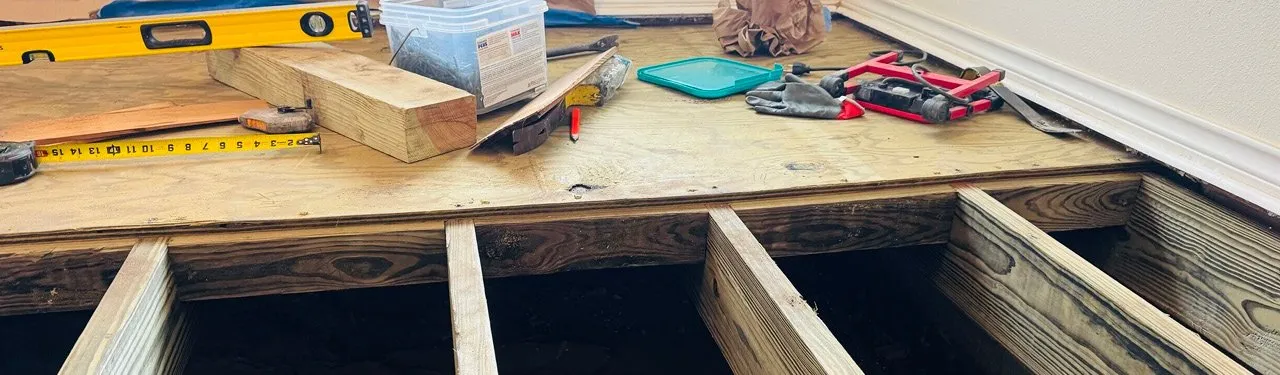
A crawl space rebuild means the entire floor support structure, from the subfloor down, is removed and replaced. The work is done from the top down. In other words, crews cut into your floors from inside the home to access the area.
Side note: You likely need to move out for this kind of rebuild work, especially if it involves major areas of your home or the whole darn thing.
Here is what a typical rebuild includes:
- Sill beams (all types: main sills, shaker sills, mud sills if applicable)
- Floor joists — the framing members that span between sills and support the floors
- Subfloor — the rough floor surface that your finish flooring sits on top of
A rebuild does not include anything above the subfloor, as in, no finish flooring, wall framing, or siding. That said, since the subfloor gets cut out, your finish flooring will need to come up and be replaced afterward. That is a separate cost worth factoring in.
Sometimes a rebuild also includes correcting poor original construction: joists spaced too far apart, sills in the wrong positions, or support stations that were never adequate. When crews already have full access, it is a good time to fix what should have been done right the first time.
How Is a Rebuild Different Than a Repair?
A crawl space repair fixes what is broken or compromised without cutting into the floor from above. All the work happens from underneath, which is also why this type of work is called “house leveling.”
The less-invasive “repair from underneath” is the preferred approach for you as a homeowner. Repairs from below cost less, cause less disruption, and do not require you to move out. The work is still physically demanding for the foundation repair contractor (army crawling in a tight space in Texas heat is no picnic), but the impact on your daily life and pocketbook is much lower.

Crawl space repairs can cover a wide range of work, including:
- Removing and replacing sills or mud sills damaged by moisture, wood rot, or termites — as long as the subfloor above is still intact
- Adding or sistering floor joists when joists are failing or original spacing was insufficient
- Adjusting, replacing, or adding support piers that have settled or degraded (pier types vary across crawl space homes)
- Adding new support material, like shaker sills, where floors are bouncy or under-supported
- Raising and leveling the home to bring doors, floors, and walls back into alignment
For a deeper look at everything that can go into a repair, our article on fixing pier and beam foundation damage covers it well.
Why Would I Need a Rebuild Instead of a Repair?
Short answer: if your subfloor is compromised, a rebuild is required for those areas. There is no way to fix your subfloor from below. It all has to be torn out and redone.
When the subfloor is damaged from moisture, wood rot, or termites, the only fix is to cut it out and replace it from the top down. That process also requires pulling the sills and joists beneath it, because they’re almost always degrading too . . . which is what makes it a full rebuild.

The most common reasons a subfloor gets compromised:
- Wood rot from moisture — chronic dampness from poor drainage, plumbing leaks, or low crawl space clearance breaks down the wood over time. Soft, spongy, or “giving” floors are a common sign.
- Termites — if damage has only reached sills and joists, repair may still be possible. Once termites get to the subfloor, a rebuild is on the table. Learn more about termite damage in crawl spaces.
- Age and deterioration — in some older homes, the entire wood structure is at end of life. Wood don’t last forever! Rebuilding becomes more practical than patching because everything is affected.
One thing worth knowing: subfloor damage does not always announce itself loudly. Floors that feel only slightly soft can be hiding more serious damage underneath. That is exactly why an in-person inspection that includes crawling under the home matters.
How Will I Know Which One Needs to Be Done?
So how do you know which one is right for you?? The homeowner does not need to make this call in most cases, and that is good news. This is determined by what is physically found under your home. You are not expected to figure it out yourself.
The rebuild vs. repair decision comes down to two questions:
- Is the subfloor compromised? If yes, a rebuild is needed in those areas. If the subfloor is intact and damage is limited to what is below it, repair is possible.
- Is there enough clearance to work from below? If a crew cannot safely access and maneuver in the crawl space, coming in from above may be the only option — even if the subfloor is otherwise okay.
One more thing worth knowing: sometimes a contractor recommends the top-down approach not because the home strictly requires it, but because it is physically easier to access and work from above in certain situations. Not every contractor will lead with the under-home approach when they have a choice.

It’s hard work to crawl around under a home, so some contractors just don’t wanna do it and opt for the rebuild even when it’s not 100% necessary . . . easier for them, and costs more too, so it’s also better for their bottom line.
At Anchor, we don’t operate that way. We only come in from above when it is truly the only option due to subfloor replacement or legit lack of clearance. For us, it’s never about what’s hard or easy for us, it’s about what’s right for you.
Our article on crawl space repair approaches explains this in more detail if you want the full picture.
Getting to the Right Answer for Your Home
Now you know the key difference. A repair works from underneath — sills, joists, piers, support — as long as the subfloor is solid. A rebuild comes in from above when the subfloor is compromised or access from below is not possible. Neither is better in every case; it depends entirely on what is going on under your home.

At Anchor Foundation Repair, we have been doing both repairs and rebuilds for over 40 years in Bryan, College Station, and throughout the Brazos Valley. We tell you what we find, explain our reasoning, and do not push work that is not needed.
So now you’ve got some bids to compare with more understanding about the rebuild vs. repair issue, one of them might even be from us! If you’re unsure of how to pick the best contractor from the estimates you’ve gotten, you might look here for guidance: Tips To Compare House Leveling Bids From Different Contractors.